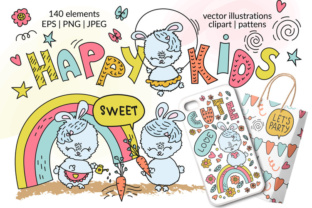
Happy Kids Vector Illustration: A Versatile Creative Resource for Print, Design, and Education
Vector illustration sets like Happy Kids Vector Illustration serve as foundational tools across disciplines — from commercial design and small-business branding to classroom activities and therapeutic crafts. Unlike raster images, vector-based assets retain crisp clarity at any scale, making them indispensable for projects requiring flexibility in output size and format. The Great Cartoon Complete HAPPY KIDS collection exemplifies this utility through its intentional structure, thoughtful file diversity, and broad compatibility — all centered around joyful, inclusive, and expressive child-themed visuals.
Why Vector Format Matters Across Real-World Applications
At the core of this set’s practical value is its native vector foundation. Each of the five primary files arrives in Adobe Illustrator .EPS format, fully editable in industry-standard applications such as CorelDRAW, Adobe InDesign, and Affinity Designer. This isn’t just about scalability — it’s about adaptability. A teacher designing a bilingual classroom poster can isolate and recolor individual elements (e.g., swapping a backpack’s hue to match school colors) without pixelation or quality loss. A boutique owner printing fabric swatches for baby apparel can resize seamless patterns to tile across meters of material while preserving edge alignment and color fidelity. Even hobbyists creating 3D pop-up cards benefit from layered vector paths that allow precise cutting instructions in Cricut Design Space or Silhouette Studio.
RGB color mode ensures consistency for digital previews and screen-based mockups, while also serving as a reliable starting point for CMYK conversion during professional print production. Because no rasterization occurs until final output, designers retain full control over stroke weight, fill opacity, grouping logic, and typography integration — critical when customizing greeting cards or planner stickers for niche audiences.
Comprehensive File Structure Designed for Workflow Efficiency
The Happy Kids Vector Illustration package avoids the common pitfall of “one-size-fits-all” bundles by organizing assets according to functional purpose:
- 5 editable .EPS vector files with matching .JPG previews (300 DPI): These serve as curated scene compositions — think playground vignettes, birthday celebrations, or learning moments — ideal as standalone wall art or invitation backdrops. Their layered construction enables selective editing: remove a balloon but keep confetti; shift a character’s pose without altering background gradients.
- 2 Latin-alphabet lettering sets in transparent .PNG (300 DPI), offered in both full-color and black-and-white variants: Useful not only for crafting custom name banners or educational flashcards but also for accessibility adaptations — high-contrast black text supports visual learners, while colored versions aid early literacy through associative color-coding.
- 75 individual .PNG objects with alpha channels (300 DPI): From smiling animals holding books to diverse children riding tricycles or planting seeds, these isolatable elements empower modular design. Educators use them to build interactive social-emotional learning worksheets; event planners layer them onto photo collages for personalized party signage; textile designers scatter them across repeat layouts for organic fabric prints.
- 4 seamless vector patterns (.EPS + .JPG preview, 300 DPI): Unlike tiled bitmap patterns prone to visible seams or resolution collapse, these vector repeats maintain mathematical precision regardless of scale. They function equally well as subtle notebook backgrounds or bold wallpaper motifs — especially valuable for interior designers specifying nurseries or pediatric clinic waiting areas.
- 4 ready-to-print .JPG cards (2480×3508 px, 300 DPI): Sized for standard A4/letter trim, these provide immediate usability for greeting cards, thank-you notes, or developmental milestone announcements. Their inclusion bridges the gap between digital creation and physical delivery — no layout software required for basic personalization.
Practical Use Cases Beyond Commercial Printing
While T-shirts, postcards, and home décor are obvious applications, the Happy Kids Vector Illustration set demonstrates unexpected versatility in specialized contexts:
Educational Resource Development: Curriculum designers integrate the PNG objects into interactive PDFs or Google Slides activities — dragging and dropping characters to sequence stories or label anatomy diagrams. The absence of embedded text allows educators to add multilingual labels or simplify vocabulary for emerging readers.
Clinical and Therapeutic Settings: Occupational therapists use scalable vector scenes to create customized visual schedules or emotion-identification charts. Because each child figure is distinct in expression, posture, and accessory, clinicians can select representations aligned with a client’s identity or therapeutic goals — supporting neurodiverse engagement without relying on generic clipart.
Community-Based Projects: Nonprofits organizing summer reading programs or neighborhood festivals download and adapt the seamless patterns for banners, tote bags, or temporary sidewalk chalk stencils (converted via vector-to-outline export). The unlimited usage license means one purchase supports dozens of printed materials across multiple events — a cost-effective alternative to commissioning bespoke illustrations.
Small-Business Branding: Daycare centers, children’s book illustrators, or toy retailers leverage the editable EPS files to develop cohesive brand extensions: adapting a central character into a logo mark, extracting icons for app interfaces, or generating animated SVG sequences for website micro-interactions.
Technical Considerations for Optimal Results
Despite its user-friendly packaging, successful implementation depends on understanding key technical boundaries. First, while .PNG files support transparency and are widely compatible, they are raster-based — meaning resizing beyond original dimensions risks blurriness. For maximum flexibility, users should prioritize the .EPS source files whenever possible and reserve .PNGs for final-stage placement where resolution is fixed (e.g., embedding into a pre-sized Canva template).
Second, RGB color values do not translate identically to CMYK print processes. Users preparing files for offset or large-format printing should convert color profiles *after* final edits and conduct test prints on target paper stock — especially important for skin tones and pastel palettes present in the Happy Kids Vector Illustration set. Professional print services often provide ICC profiles specific to their equipment; applying these ensures faithful reproduction of cheerful yellows, soft blues, and warm flesh tones.
Third, the inclusion of Latin-alphabet lettering does not imply linguistic limitation. Designers routinely pair these fonts with custom-drawn glyphs or imported OpenType fonts to create bilingual materials — for instance, overlaying Spanish verbs onto illustrated action scenes or integrating Arabic numerals alongside counting visuals.
Accessibility and Ethical Design Implications
The set’s emphasis on diversity — evident in varied skin tones, abilities (e.g., children using wheelchairs or hearing aids), and cultural signifiers (headscarves, traditional footwear) — aligns with contemporary best practices in inclusive visual communication. When used intentionally, these representations foster belonging in educational materials and public-facing resources. However, responsible application requires contextual awareness: pairing imagery with accurate narratives, avoiding stereotypical scenarios, and supplementing with real-world references where appropriate.
Equally important is the ethical reuse framework. The license permits unlimited application across personal, educational, and commercial projects — but prohibits redistribution of unaltered source files or resale as standalone digital products. This balance supports both creator sustainability and user autonomy, allowing teachers to print 500 stickers for a school fair without licensing anxiety, while ensuring original artists retain rights to their intellectual property.
Integration Into Broader Creative Ecosystems
Modern creative workflows rarely rely on isolated assets. The Happy Kids Vector Illustration set functions seamlessly within larger toolchains: imported into Figma for collaborative UI prototyping of children’s apps; converted to SVG for web-based interactive storytelling; or processed through AI-assisted color-palette generators to extend the existing scheme into complementary gradients or data-visualization elements. Its clean paths and minimal anchor points also reduce rendering load in performance-sensitive environments like mobile AR experiences or low-bandwidth educational platforms.
For researchers studying visual cognition in early childhood, the standardized proportions and consistent stylistic language across the 75 PNG objects offer a controlled stimulus set — enabling replication across studies without variability introduced by inconsistent line weight or perspective distortion.
In sum, the Happy Kids Vector Illustration collection transcends its surface-level description as a “cartoon pack.” It is a thoughtfully engineered system — technically robust, pedagogically adaptable, ethically grounded, and practically extensible. Whether you’re prototyping a new product line, scaffolding a lesson plan, or refreshing community outreach materials, its components provide reliable building blocks rooted in quality, clarity, and creative respect.