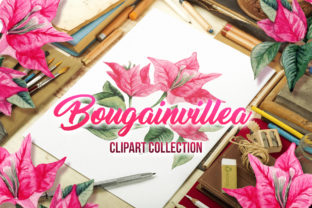
Bougainvillea Floral Clipart: A Versatile Resource for Designers, Educators, and Plant Enthusiasts
Among the most vivid and resilient flowering plants in the world, bougainvillea stands out not only for its cascading bursts of papery bracts—but also for its remarkable adaptability across visual media. Its bold silhouettes, layered petal structures, and rhythmic vine growth make it a natural favorite for botanical illustration. That’s why Bougainvillea Floral Clipart has emerged as more than just decorative assets—it’s a functional toolkit rooted in observational accuracy and artistic intention. This collection—born from deep appreciation for the plant itself—offers 30 high-resolution PNG elements, two layered PSD files for editable customization, and two seamless patterns designed for repeat use without visual fatigue.
Why Bougainvillea Translates So Well to Digital Botanical Art
Bougainvillea isn’t merely ornamental; its morphology carries inherent design intelligence. The plant’s true flowers are small and white, but they’re surrounded by three large, waxy bracts—often mistaken for petals—that come in saturated magentas, oranges, pinks, purples, and creams. This contrast between delicate center and dramatic outer form creates strong visual hierarchy—a quality that translates seamlessly into scalable vector-like raster assets. Unlike flatter florals such as daisies or lilies, bougainvillea offers built-in depth through overlapping bracts, twisting stems, and clustered inflorescences. That structural richness is preserved in this Bougainvillea Floral Clipart set through careful watercolor layering and hand-drawn linework.
Each element was developed using traditional watercolor techniques first—pigment saturation, wet-on-wet blending, subtle granulation—then digitized with fidelity to texture and transparency. The result? Assets that retain organic warmth while functioning flawlessly in digital workflows. Whether placed against a crisp white background or layered over textured paper scans, these illustrations avoid the sterility sometimes associated with stock botanicals.
Real-World Applications Across Diverse Fields
The versatility of this collection lies not in its quantity—but in how each asset supports distinct professional needs. Below are concrete examples drawn from actual usage patterns among designers, educators, and small business owners:
- Surface Pattern Designers: The two seamless patterns included—each built from rotated, scaled, and color-shifted variations of core bougainvillea motifs—enable immediate textile, wallpaper, or wrapping paper mockups. One pattern emphasizes tight vine repetition ideal for scarves; the other uses spaced clusters suited for ceramic tile layouts.
- Educational Content Creators: Science teachers use individual stem-and-bract PNGs to annotate pollination pathways or compare bract vs. sepal function. Homeschool curriculum designers integrate layered PSD files into interactive PDFs where students toggle visibility of vascular tissue overlays or seasonal growth stages.
- Small-Batch Product Brands: A boutique soap maker applied a single bougainvillea bloom (with transparent background) to shrink-wrap labels, then reused the same file—mirrored and recolored—to create cohesive Instagram story templates. No redrawn assets. No licensing ambiguity.
- Academic Researchers: Botanists compiling regional flora databases have used the clean line-art variants (included in the PNG set) as base references for field guide illustrations—adding species-specific annotations without redrawing foundational structure.
Technical Strengths That Support Long-Term Usability
Many floral clipart sets prioritize aesthetics over utility. This Bougainvillea Floral Clipart collection prioritizes both—by embedding practical functionality at the file level:
- 30 PNG Elements: Each saved at 300 DPI with transparent backgrounds, supporting print-ready applications without clipping masks or background removal. Variants include isolated blooms, leaf-and-tendril combos, bud clusters, and full vine sections—organized by scale and orientation to reduce layout friction.
- 2 Layered PSD Files: These aren’t flattened compositions. One features bract layers separated by hue group (magenta, coral, cream), enabling non-destructive color experiments. The second isolates structural components—stems on one layer, bracts on another, stamens on a third—so users can adjust proportions or remove elements for simplified diagrams.
- Seamless Patterns: Built using Photoshop’s pattern preview mode and tested across 12-inch swatches, both patterns avoid visible seams even when tiled across large-format prints. Each includes a matching 12x12 inch JPEG swatch for quick client previews.
This attention to technical detail reflects an understanding that usability isn’t theoretical—it’s measured in minutes saved during production, fewer revision rounds with clients, and reduced cognitive load when building complex compositions.
How Hand-Drawn Origins Enhance Authenticity and Adaptability
Digital tools offer speed—but hand-drawn origins provide nuance. Every line in this collection began as ink on cold-press watercolor paper, capturing the slight irregularity of natural growth: a vine that curves left before looping right, a bract edge that thins toward the tip, subtle asymmetry in paired leaves. That human touch prevents the “too-perfect” look that can undermine credibility in scientific or artisan contexts.
Consider a university extension program creating drought-resilience gardening guides. Using algorithmically generated bougainvillea icons might communicate “plant,” but not “this specific, heat-tolerant cultivar.” In contrast, the slight variation in bract width and stem taper found in these hand-drawn elements signals observational rigor—reinforcing E-E-A-T (Experience, Expertise, Authoritativeness, Trustworthiness) for readers evaluating horticultural advice.
Similarly, craft entrepreneurs selling handmade greeting cards report higher perceived value when their designs feature illustrations with visible brush grain and pigment bleed—even when printed digitally. That tactile authenticity bridges physical and digital consumer expectations.
Integrating Bougainvillea Clipart Into Existing Workflows
Adoption doesn’t require overhauling software habits. Here’s how professionals embed this collection efficiently:
- Adobe Creative Cloud Users: Drag PNGs directly into Illustrator for tracing or into InDesign for multi-page layouts. Load PSDs into Photoshop for selective recoloring using Hue/Saturation adjustment layers—preserving original luminosity.
- Procreate & Affinity Designer Users: Import PNGs as layered canvases; use alpha lock to add custom shadows or texture brushes without affecting transparency. Resize patterns using the built-in pattern fill tools—no manual tiling needed.
- Canva & Figma Users: Upload PNGs as brand assets; apply duotone filters for consistent color branding across social posts. Use pattern JPEGs as background fills in presentation templates—scaling automatically with frame size.
- Print-on-Demand Sellers: Combine vine elements with custom typography in place of generic floral borders. Use the seamless patterns as all-over shirt prints—verified to align correctly across garment sizes via standard POD template guides.
Thoughtful Considerations for Ethical and Effective Use
While accessibility and flexibility are strengths, responsible application requires awareness:
- Cultural Context Matters: Bougainvillea holds symbolic meaning across regions—from celebration in Southeast Asia to resilience in arid Mediterranean communities. Avoid pairing illustrations with stereotypical or reductive narratives unless grounded in verified local knowledge.
- Scale Accuracy Is Optional—but Intentional: These illustrations aren’t taxonomic diagrams. They emphasize aesthetic harmony over strict botanical proportion. If scientific precision is required (e.g., for herbarium documentation), pair them with verified reference images—not as substitutes.
- Licensing Clarity: All assets are licensed for commercial use—including merchandise, digital products, and client work—with no attribution required. However, resale of unmodified PNGs as standalone clipart violates terms. The value lies in integration, not extraction.
Looking Beyond Decoration: Bougainvillea as a Design Catalyst
What begins as a simple search for “bougainvillea clipart” often evolves into deeper engagement—with plant morphology, regional horticulture, and sustainable design practices. Users report sketching companion vines after studying the stem curvature in the PSD files; others research native pollinators after noticing how the bract arrangement invites certain bee species.
That ripple effect underscores a quiet truth: well-crafted botanical assets don’t just fill space—they invite inquiry. When a teacher selects a bougainvillea bloom to illustrate photosynthesis, students notice the waxy cuticle. When a packaging designer chooses a vine motif for a botanical tea label, consumers subconsciously associate the product with vibrancy and endurance.
This Bougainvillea Floral Clipart collection succeeds not because it covers every possible variation—but because it honors the plant’s essence while removing friction between inspiration and execution. It meets creators where they are: balancing deadlines and detail, scalability and soul, efficiency and authenticity.
Final Note on Evolution and Utility
Unlike trend-driven graphics that fade with seasonal palettes, bougainvillea’s enduring visual language ensures longevity. Its forms adapt to minimalist line art, maximalist collage, muted earth tones, or neon gradients—without losing recognizability. That timelessness, combined with deliberate technical execution, makes this collection less of a “download” and more of a working reference library: one that grows more valuable with each project it enables.