Fun and Positive Tropical Backgrounds
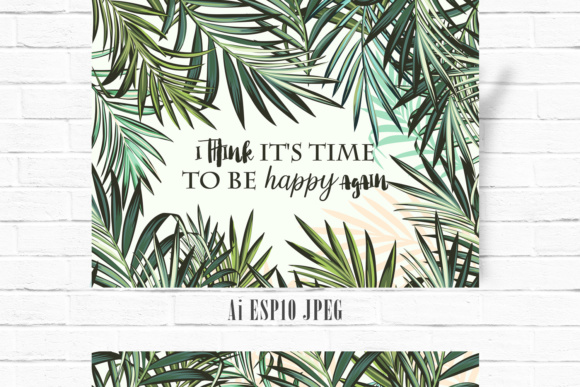
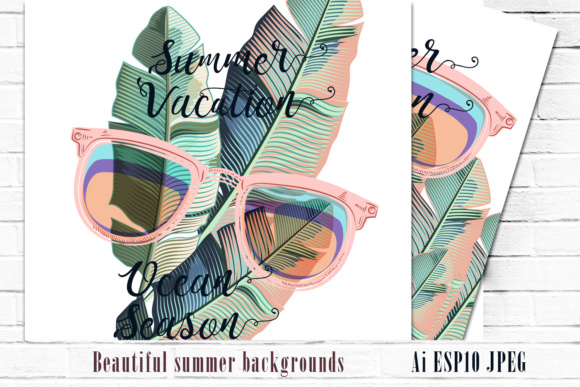
Fun and Positive Tropical Backgrounds is a curated vector design pack built for creators who need high-fidelity, joyful visual assets that communicate warmth, energy, and approachability—without sacrificing professional polish. At its core, it’s a set of 100 meticulously hand-drawn tropical motifs: palm leaves rendered with expressive line work, stylized fronds wearing sunglasses, playful botanical silhouettes, and rhythmic organic shapes—all designed to function as flexible, scalable foundations for real-world projects.
Unlike generic stock patterns or low-resolution clipart, these backgrounds are created with intentional detail and technical precision. Each element is drawn by hand first, then vectorized to ensure crisp rendering at any size—from a business card thumbnail to a 12-foot trade show backdrop. The result is a resource that supports both creative expression and production reliability.
Where These Backgrounds Fit in Your Workflow
Fun and Positive Tropical Backgrounds isn’t just decoration—it’s a workflow accelerator. It slots into your process where visual tone matters most: early in concept development, mid-stream during asset assembly, or late-stage when refining deliverables for client or audience impact.
For designers building brand identities for wellness studios, travel startups, or eco-conscious product lines, these backgrounds provide immediate visual shorthand. Instead of spending hours sketching mood boards or sourcing fragmented assets, you can start with a consistent, on-brand aesthetic foundation. That saves time in the discovery phase and reduces back-and-forth with stakeholders over “vibe alignment.”
For educators crafting summer-themed lesson plans or marketers preparing seasonal campaigns, the pack serves as a ready-made visual language. A single palm leaf with sunglasses becomes an anchor motif—reused across slide decks, printable worksheets, email headers, and social media carousels. Consistency emerges naturally, not through extra effort.
Practical Use Cases Across Roles
Different professionals integrate Fun and Positive Tropical Backgrounds based on their output needs—not just their job titles. Here’s how it works in practice:
- Freelancers and small business owners use the JPEG previews (5000×5000 px) for quick mockups—layering them behind product shots in Canva or Photoshop to pitch branded merchandise like tote bags or enamel pins before committing to print runs.
- Textile and surface designers import the EPS10 and AI CS2 files directly into Adobe Illustrator to build seamless repeats. The clean vector paths allow precise control over spacing, rotation, and color overrides—critical when adapting patterns for fabric dyeing or wallpaper printing.
- Event planners and wedding professionals pull individual elements (like a single leaf cluster or sunburst frame) to customize save-the-date cards, digital invitations, or printed signage—ensuring cohesion across physical and digital touchpoints without hiring a designer for every variation.
- Bloggers and content creators embed background sections as section dividers or featured image overlays. Because each file is high-resolution and transparent-ready (via vector layers), they integrate cleanly into WordPress themes or newsletter builders without pixelation or layout distortion.
Compatibility and Technical Integration
The format selection—2 AI CS2, 2 EPS10, and 2 high-res JPEG previews—isn’t arbitrary. It reflects real software constraints and team collaboration needs. AI CS2 files retain full editability in older Illustrator versions still used by print shops or agencies with standardized setups. EPS10 ensures compatibility with CorelDRAW, Affinity Designer, and legacy prepress workflows. The JPEGs serve as universal reference points—shared with clients, developers, or printers who don’t need editable vectors but require accurate color and composition previews.
No fonts, raster effects, or linked assets are embedded—every shape is outlined, every gradient converted to flat swatches. This eliminates version conflicts and missing-resource warnings when handing off files across teams or platforms. If you’re working in Figma, you can place the JPEGs as image fills or trace the EPS into vector shapes using auto-trace tools—no plugin required.
Quality Control and Long-Term Usability
“Highly detailed” here means intentional design decisions—not visual clutter. Each palm leaf has varied stroke weights, subtle tapering at the tips, and organic asymmetry that avoids robotic repetition. That level of craft translates directly to perceived quality: printed fabric feels premium, web graphics load crisply, and presentation slides project confidence—not filler.
To maintain that standard over time, organize your library intentionally. Create a dedicated folder labeled “Tropical Backgrounds – Editable” for the AI/EPS files and “Tropical Backgrounds – Preview & Export” for JPEGs and exported PNGs. Name variants clearly: “Palm_Sunglasses_Single_Leaf_Red.ai”, “Palm_Pattern_Seamed_Repeat_Blue.eps”. This prevents version sprawl and makes reuse faster—especially when juggling multiple client projects or seasonal updates.
Also consider color strategy upfront. The pack doesn’t lock you into preset palettes. Because all elements are vector-based, you can recolor entire groups in seconds using Illustrator’s Recolor Artwork tool—or apply global swatches that update across dozens of objects simultaneously. That means one background can support a pastel spring palette for a baby shower and a saturated coral-teal scheme for a surf school rebrand—without redrawing anything.
Efficiency Without Compromise
What separates Fun and Positive Tropical Backgrounds from generic alternatives is its balance of speed and specificity. You’re not choosing between “fast” and “custom”—you’re getting both. The hand-drawn character gives warmth; the vector precision gives control; the variety (100 distinct assets) gives flexibility.
In practice, that means less time troubleshooting resolution issues, fewer rounds of client revision due to unclear visual direction, and more bandwidth to focus on messaging, user experience, or strategic positioning. For example, a small-batch candle maker launching a “Coastal Calm” collection can use one background as the label base, another as the Instagram story template, and a third as the header for their Shopify product page—all sourced from the same trusted set, all aligned in tone and execution quality.
It also supports iterative improvement. Because each file is modular, you can test variations rapidly: rotate a leaf cluster 15 degrees for better flow on a t-shirt chest print, isolate three elements to build a custom watermark, or combine two patterns with blending modes to create depth in a presentation slide. There’s no need to wait for new assets—you adapt what’s already proven and polished.
Making It Part of Your Routine
Start small. Pick one upcoming project where visual consistency matters—like a quarterly newsletter or a product launch campaign—and commit to using only assets from this pack for all background elements. Notice how much faster layout decisions become when you’re not scrolling through 200 unrelated options.
Then expand. Add a naming convention to your design system documentation: “Tropical Backgrounds v1 – Primary Pattern Set.” Tag related files in your cloud storage with that label. When onboarding a new contractor or intern, share the folder alongside a one-paragraph usage note—not a lengthy style guide.
Over time, this pack stops being “an asset you bought” and becomes part of your visual vocabulary—like a trusted typeface or a go-to photo filter. It’s not about using every leaf or repeating the same pattern everywhere. It’s about having reliable, joyful, technically sound foundations—so your energy stays focused on what matters most: clarity, connection, and execution.