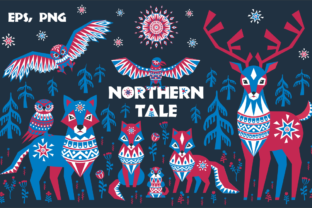
Northern Tale. Arctic Animals in Tribal Style.
When visual language aligns with intention—not trend—the result is more than decoration. It’s resonance. Northern Tale. Arctic Animals in Tribal Style. is a purpose-built creative resource: 25 meticulously crafted vector clip arts and 3 seamless patterns, delivered in production-ready formats (EPS and high-resolution 300dpi PNG with transparent backgrounds). But its strategic value lies not in volume or format alone—it lies in how deliberately it bridges cultural motif, ecological symbolism, and functional design.
Why This Collection Supports Intentional Creative Work
Tribal-style illustration carries weight. It signals heritage, continuity, and reverence for natural systems—qualities increasingly sought by audiences who prioritize authenticity over polish. The arctic animals featured—polar bears, snowy owls, arctic foxes, walruses, narwhals, musk oxen, and more—are rendered not as cartoonish icons but as stylized archetypes: bold linework, rhythmic negative space, and motifs inspired by Inuit, Sámi, and broader circumpolar visual traditions. That specificity matters. It avoids appropriation through abstraction; instead, it invites respectful reinterpretation grounded in form, not fiction.
For creators building brands, products, or educational materials around sustainability, resilience, or northern identity, Northern Tale. Arctic Animals in Tribal Style. offers a shortcut to visual coherence—without sacrificing originality. A small-batch apparel brand launching a “Climate Keepers” line can use the polar bear motif across labels, hang tags, and social banners—not as filler, but as a unifying symbol of stewardship. An environmental educator developing classroom posters can layer the snowy owl into infographics about biodiversity loss, letting its presence reinforce narrative without explanation.
Strategic Use Across Real-World Contexts
The package’s technical flexibility enables precision—not just convenience. Each EPS file is fully editable in Illustrator: stroke weight, color palette, and scale can be adjusted without degradation. That means you’re not locked into someone else’s vision. You’re given raw material calibrated for adaptation.
- Digital art prints: Scale the EPS files to any dimension for gallery-quality giclée output—no pixelation, no guesswork. Pair the seamless reindeer-pattern EPS with a muted oatmeal background for a limited-run print series that feels tactile and timeless.
- T-shirts and textiles: Use the transparent-background PNGs for direct-to-garment printing. Because they’re 300dpi and cleanly isolated, halftones and fine linework hold up even on textured organic cotton.
- Greeting cards and stationery: Layer the fox motif subtly into corner flourishes or use the seamless snowflake pattern as a watermark behind handwritten messages—elevating perceived craftsmanship without overwhelming the message.
- Mugs and ceramics: Vector paths convert reliably to ceramic decal printers. The clean outlines ensure crisp firing results—even at small sizes like mug handles or coaster edges.
This isn’t about swapping one generic icon for another. It’s about selecting assets that carry semantic weight *and* technical reliability—so your time goes toward strategy and storytelling, not troubleshooting raster artifacts or licensing ambiguities.
When—and When Not—to Reach for Northern Tale
Use this collection when your goal demands symbolic clarity paired with executional control. If you’re designing a campaign about ecological interdependence, the interconnected linework in the walrus-and-ice pattern communicates complexity without clutter. If you’re developing a wellness brand rooted in stillness and endurance, the stoic posture of the tribal musk ox conveys quiet strength more effectively than stock photography ever could.
Don’t reach for it when context contradicts its intent. Slapping the narwhal motif onto a fast-fashion discount flyer dilutes its resonance—and risks appearing tone-deaf. Likewise, avoid using these elements without understanding their implied associations: cold, patience, adaptation, silence, survival. They are not neutral. They carry atmosphere. That’s an advantage—if acknowledged.
Also consider audience literacy. Urban millennials may recognize tribal motifs as markers of craft and care; younger audiences or global markets unfamiliar with circumpolar traditions may read them more abstractly—as “cool patterns”—which isn’t wrong, but changes the communicative return. Align usage with your audience’s interpretive framework, not just your aesthetic preference.
Planning Your Implementation Thoughtfully
Start with function, not form. Before opening the ZIP file, ask:
- What outcome do I need this asset to support? (e.g., increase perceived brand authenticity, simplify complex environmental data, differentiate packaging on crowded shelves)
- Where will it appear—and at what scale? (A 12px favicon won’t benefit from intricate linework; a 48" wall mural needs vector scalability.)
- What other visual elements will surround it? (Does your brand palette include deep indigo and charcoal? Then the arctic fox in monochrome EPS saves hours of recoloring.)
- Who owns the final interpretation? (If handing off to a freelance designer, share the cultural context notes—not just the files—so decisions remain intentional.)
One practical tip: extract and test individual motifs against your brand’s existing assets before full integration. Drop the tribal seal into your email template header beside your logo. Print the seamless ice pattern at actual size on your chosen paper stock. See how it holds up—not just aesthetically, but operationally.
Risks of Unanchored Usage
Without clear goals or contextual awareness, even well-designed assets can backfire. Using Northern Tale. Arctic Animals in Tribal Style. as decorative “filler” risks flattening its cultural resonance into cliché—like using dreamcatchers as generic boho decor. Worse, inconsistent application (e.g., mixing the tribal fox with photorealistic penguins or tropical foliage) fractures visual logic and weakens brand cohesion.
There’s also a subtle operational risk: assuming “vector = always ready.” While the EPS files are editable, they assume familiarity with Illustrator’s path tools. If your team lacks that skill, budget time—or training—for proper manipulation. Otherwise, you’ll default to scaling and recoloring only, missing half the collection’s utility.
Long-Term Value Beyond the First Project
Think of Northern Tale. Arctic Animals in Tribal Style. not as a one-off download, but as a modular visual vocabulary. The 25 clip arts aren’t isolated images—they’re a system. Notice how the curve of the whale’s tail echoes the swirl of the aurora pattern; how the fox’s ear mirrors the rhythm in the snowdrift repeat. That consistency allows for iterative development: launch with the polar bear on packaging, then introduce the owl in seasonal email campaigns, then unify both in an annual impact report—all feeling like chapters of the same story.
That kind of continuity builds recognition without repetition. And because the files are yours—no subscriptions, no usage caps—you retain full control over evolution. You can adapt colors for new product lines, isolate elements for animated social posts, or combine motifs into custom watermarks for client deliverables. The long-term ROI isn’t in the first use. It’s in how many future decisions become faster, clearer, and more aligned—because the foundational visual language is already coherent, credible, and technically sound.
Final Strategic Observation
Creative resources earn their value not from how many times they’re used—but from how meaningfully they’re applied. Northern Tale. Arctic Animals in Tribal Style. gives you the tools to signal depth, not just design. To reflect values, not just fill space. To connect with audiences on a level deeper than aesthetics—through shared respect for endurance, balance, and the quiet power of the north. Use it where intention meets execution. That’s where distinction begins.