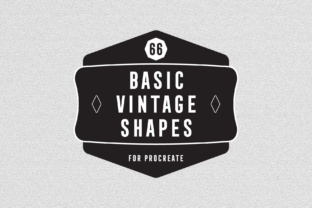
Basic Vintage Shapes – Procreate Brush: A Design Tool for Authentic Visual Storytelling
Designers across industries—from boutique branding studios to independent apparel labels—are increasingly turning to tactile, historically grounded aesthetics to differentiate their work. In this context, the Basic Vintage Shapes – Procreate Brush stands out not as a novelty, but as a precision-crafted tool that bridges archival sensibility with modern digital workflow. Unlike generic shape libraries or vector-based assets, this custom brush set is built exclusively for Procreate on iPadOS—leveraging pressure sensitivity, tilt response, and layer blending in ways that mimic traditional ink, stamping, and hand-cut collage techniques. Its value lies not in visual nostalgia alone, but in how it supports intentional, repeatable, and context-aware design decisions.
How These Brushes Function Differently Than Standard Shape Tools
Most digital shape tools rely on vector paths or rasterized icons inserted as static layers. The Basic Vintage Shapes – Procreate Brush operates at the pixel level—but intelligently. Each shape (circles, ovals, stars, shields, badges, chevrons, scalloped borders, and simplified florals) is encoded as a dynamic brush tip with calibrated grain, edge softness, and opacity falloff. When used with an Apple Pencil on an iPad Pro, strokes respond to tilt for subtle shading, pressure for line weight variation, and speed for controlled texture density. This means a single “vintage badge” shape can be drawn once as a crisp monochrome label, again with light pressure to suggest faded screen-print ink, and a third time tilted at 30° to emulate embossed foil stamping—all within the same document and without switching tools.
This behavior enables what designers call contextual fidelity: the ability to match visual tone to medium and audience. A craft brewery’s bottle label benefits from slightly irregular edges and organic spacing; a heritage textile brand may prioritize symmetry and clean outlines. Because these brushes are raster-native and resolution-independent up to 300 DPI, they scale cleanly for both 4″ × 6″ sticker sheets and 48″ × 96″ trade show banners—without vector conversion artifacts or manual cleanup.
Real-World Applications Across Creative Disciplines
The versatility of the Basic Vintage Shapes – Procreate Brush emerges most clearly when observed across distinct professional contexts—not as a one-size-fits-all asset, but as a modular component in varied workflows.
Branding & Corporate Identity Development
Identity systems require consistency *and* adaptability. Designers use these shapes to build foundational elements—logomarks built from interlocking shields or concentric rings, patterned submarks derived from repeating chevrons or scallops, and typographic frames that wrap around wordmarks. Because each shape responds predictably to Procreate’s layer modes (Multiply for ink overlays, Overlay for textured highlights), teams can rapidly prototype variations for print, web, and environmental signage—testing how a “vintage starburst” reads at 12 pt on a business card versus 120 pt on a storefront decal.
Packaging & Label Design
Food, beverage, and apothecary brands often seek authenticity through material cues: letterpress impressions, hand-stamped batch numbers, or die-cut window accents. With this brush set, designers simulate those qualities directly. A jar label might combine a bold oval base (drawn with steady pressure), a thin scalloped border (applied with quick flicks using the pencil tip), and a centered shield containing the logo—each element on its own layer for easy color adjustment or opacity tweaking. No external mockups or Photoshop plug-ins needed.
Apparel & Embroidery Prep
For screen printing or embroidery digitizing, clarity and stroke economy matter. These brushes avoid unnecessary detail while retaining stylistic voice: simplified stars with five clean points, rounded rectangles with uniform corner radii, and badges with internal negative space optimized for thread fill. Designers report reduced revision cycles because clients intuitively understand how a Procreate sketch translates to stitched fabric—especially when presented alongside physical swatches.
Pattern & Surface Design
Creating seamless repeats manually is time-intensive. But with Procreate’s Transform tool and the Basic Vintage Shapes – Procreate Brush, designers build tileable motifs in minutes. A floral motif might use three layered shapes—a central circle (for a bloom), six evenly spaced ovals (petals), and a scalloped outer ring (foliage)—all drawn freehand, then duplicated and rotated with snapping enabled. The result? A cohesive, hand-drawn pattern that avoids the mechanical repetition common in algorithmic tile generators.
Who Benefits Most—and Why
While accessible to beginners, the deepest utility of this brush set reveals itself to practitioners who understand the relationship between tool constraints and creative outcomes.
- Educators teaching analog-to-digital translation use it to demonstrate how historical printing methods—like linocut, rubber stamping, or lithographic spot-color separation—inform contemporary interface and branding choices.
- Freelance illustrators integrate the shapes into character-driven scenes: a vintage radio dial drawn with the circle brush, a retro microphone badge sketched over a portrait, or decorative borders framing editorial illustrations.
- Small-business owners designing in-house appreciate the absence of subscription fees, licensing ambiguity, or font-style dependencies—everything works offline, requires no cloud sync, and produces final files ready for CMYK prepress or DTG printer RIP software.
- Researchers studying visual semiotics apply the set to reconstruct period-accurate layouts (e.g., 1930s packaging conventions or mid-century textile catalogs), using consistent shape language to test hypotheses about perception and cultural association.
Technical Considerations for Optimal Use
Because the Basic Vintage Shapes – Procreate Brush is designed exclusively for Procreate on iOS, its performance hinges on hardware and software alignment. It requires an iPad Pro (2018 or newer) for full GPU acceleration of brush dynamics and an Apple Pencil (2nd generation recommended) to access tilt and barrel roll features. Older iPads or non-Apple styluses will render shapes—but without nuanced pressure gradients or edge softening, diminishing the expressive range.
File management also differs from desktop workflows. Brushes install directly into Procreate’s native library and cannot be exported or shared outside the app. Users should back up canvases via iCloud or local file sharing, as brush settings do not embed into .psd or .png exports. For collaborative projects, designers commonly export layered .procreate files for peer review and flattened .pngs with transparency for client presentations—preserving editability while ensuring cross-platform compatibility.
Color handling follows Procreate’s P3 wide-gamut model by default. When preparing for commercial print, designers routinely create a dedicated “CMYK Prep” layer group where shapes are recolored using process-safe palettes (Pantone Solid Coated or SWOP v2), then exported as flattened TIFFs with embedded ICC profiles—avoiding unexpected hue shifts during plate separation.
Integration Into Broader Creative Workflows
No brush exists in isolation. What distinguishes successful adoption of the Basic Vintage Shapes – Procreate Brush is how it complements—not replaces—other tools. Many professionals pair it with:
- Procreate’s Color Drop and Reference tools to maintain palette consistency across shape-based elements and hand-lettered typography;
- Vector apps like Affinity Designer or Adobe Illustrator for final output refinement—tracing key shapes to generate scalable SVGs for web use or laser-cutting templates;
- Physical prototyping tools such as desktop cutters (Cricut, Silhouette) or direct-to-garment printers, where Procreate sketches serve as precise placement guides for adhesive vinyl or heat-transfer applications.
This interoperability reflects a broader shift in creative practice: digital brushes are no longer just drawing aids, but connectors between conceptual sketch, production-ready asset, and physical artifact. The Basic Vintage Shapes – Procreate Brush functions as one node in that network—offering historical resonance without sacrificing technical rigor.
Why “Vintage” Isn’t Just a Style Choice
Vintage visual language persists not because it’s quaint, but because it communicates stability, craftsmanship, and human intention. Shapes drawn with deliberate imperfection—slight asymmetry in a star, uneven spacing in a scalloped border—signal care and attention in an era saturated with algorithmically generated perfection. The Basic Vintage Shapes – Procreate Brush supports that communication not by replicating flaws, but by encoding decision-making into the tool itself: every stroke invites the designer to choose weight, texture, and placement consciously.
In practice, this means a small-batch soap maker doesn’t just “add a circle” to a label—they consider whether that circle should sit flush against the edge (suggesting containment and purity) or float with generous margin (evoking luxury and restraint). A music festival poster designer selects a chevron not for decoration, but to imply forward motion and collective energy—then adjusts its angle and thickness to match the typography’s rhythm. These are micro-decisions, amplified by a tool built to honor them.
Ultimately, the Basic Vintage Shapes – Procreate Brush endures because it treats history not as ornament, but as methodology—a set of enduring principles made actionable through contemporary technology. It doesn’t ask users to choose between authenticity and efficiency. It asks them to draw with purpose—and lets the shapes follow.